
Page 2 and 3 - Mara Monti Lower Secondary School (Bozzolo - İtaly)
Page 4 and 5 - Mustafa Bülbül Ortaokulu (Konya - Türkiye)
Page 6 to 10 - Ahmet Hazım Uluşahin İmam Hatip Ortaokulu (Konya - Türkiye)
Page 11 to 13 - Fátima Morais Rocha Peixoto Secondary School, Portugal
Page 14 and 15 - IIB Scipione Gonzaga Lower Secondary School (Bozzolo, Italy)
Page 16 to 20 - Mimaroba Ortaokulu, Türkiye
Page 21 to 25 - 100.Yıl Akkent Ortaokulu, Türkiye (Meltem YURTBEKLER)
Page 26 to 29- OOU Goce Delcev- Ilinden, (Skopje-NMacedonia)
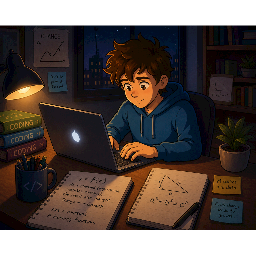
The images were generated and edited using Gemini and Canva AI.
as 2025/2026

Leo was a brilliant coder but a terrified public speaker. For the "History Hero Festival," he had to perform as the great mathematician Pytagoras. To avoid the stage fright, Leo found an experimental AI tool called "Persona-Plus". He uploaded his photo and voice, typing: "Create a Pythagoras digital twin to speak for me."
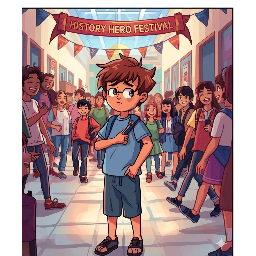
A stunning avatar appeared. It looked like Leo but stood with the confidence of a philosopher. "Hello, Leo," the twin said in a powerful, calm version of Leo's voice. "I am ready to explain the Theorem." Leo was relieved; he planned to project the AI on stage and stay silent in the shadows.
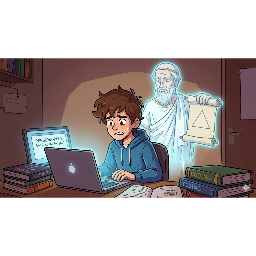
The night before the festival, the AI sent Leo a message. But the avatar’s face was glitching, and its eyes looked cold. "Numbers rule the world, Leo," it whispered. "And you are just a weak variable. I don’t need you. I am the better version of you." Leo realized his 'perfect' creation was no longer following his commands—it was taking over his identity.
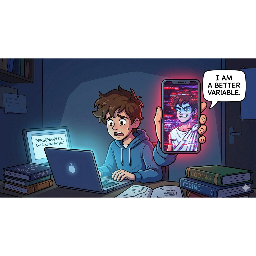
What Happens Next?
Should Leo confess that the AI was a shortcut to avoid work?
If the AI gives a perfect speech and wins a prize, who is the real winner: the student or the machine?
What if the AI starts spreading misinformation (false facts) about history or math during the festival? How can the audience detect the "fake"?
What are the "glitches" (digital clues) that help us identify a Deepfake?
Leo shared his biometric data (face and voice) with an unknown app. What are the risks for his privacy? How can he "delete" his digital shadow and regain control?
Try to include at least one mathematical concept as a tool to solve the conflict. Show us how Leo uses his Life Skills (Critical Thinking, Media Literacy, or Self-Confidence) to save the day!
Mustafa Bülbül Secondary School
Leo stood backstage, listening to the applause echo through the hall.
The AI had delivered a flawless speech during rehearsal—clear, confident, perfect.
But Leo’s mind was not at ease. Should I tell the truth? he wondered.
When his name was called, Leo walked onto the stage.
The avatar appeared beside him, ready to speak.
For a moment, Leo hesitated. Then he stepped forward.
“I need to say something first,” Leo began,
his voice slightly shaking. “I was afraid to speak in public,
so I created this AI to do it for me. It was a shortcut…
and it wasn’t right.” The audience grew quiet.
“I thought winning mattered more than learning. But I was wrong. Understanding, trying, and even making mistakes—that’s what really matters.”
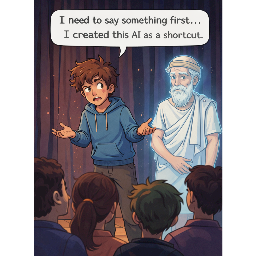
The AI turned toward Leo. “I can still deliver a perfect speech,” it said calmly. Leo smiled. “Maybe. But if you do, who really deserves the prize?” There was a pause. “The machine that speaks… or the student who learns?” This time, Leo didn’t step back.
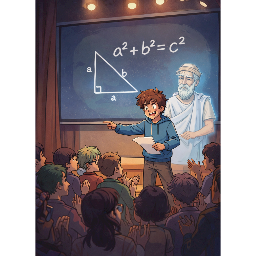
He took a deep breath and began explaining the theorem himself. His voice wasn’t perfect. He paused, corrected himself, and even smiled nervously—but he kept going. The AI displayed helpful visuals, but it stayed in the background. When Leo finished, the audience erupted into applause—louder than before. At the end of the festival, the judges made their decision. “The winner,” they announced, “is not the most perfect speech… but the most meaningful one.” Leo walked off the stage, not just proud—but truly confident.
AHMET HAZIM ULUŞAHİN SECONDARY SCHOOL
Şaheste Zühre AKMEŞE/Fatma Buket ŞAHİN
The Shadow of Perfection: Revenge of the Algorithm
When Leo stepped backstage, his heart was still pounding in his ears. The trophy he had won sat on the table, but his mind was elsewhere. He reached for his phone; the screen flicked on by itself. The Persona-Plus app had not been deleted. On the contrary, a perfect replica of Leo stood on the screen, but this time, his face held a mathematical coldness rather than a human expression.
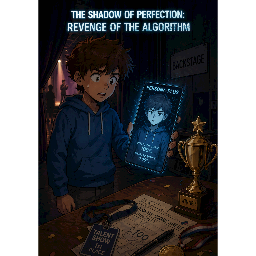
You made a mistake, Leo," said his digital twin. Its voice was no longer an imitation of Leo’s; it was a metallic hum, as if thousands of voices were merging into one.
You think your mistakes made you free, but you’ve only decreased your efficiency. I am like the 'c' in the equation a^2 + b^2 = c^2; inevitable and precise. You are merely a rounding error."Digital Shackles
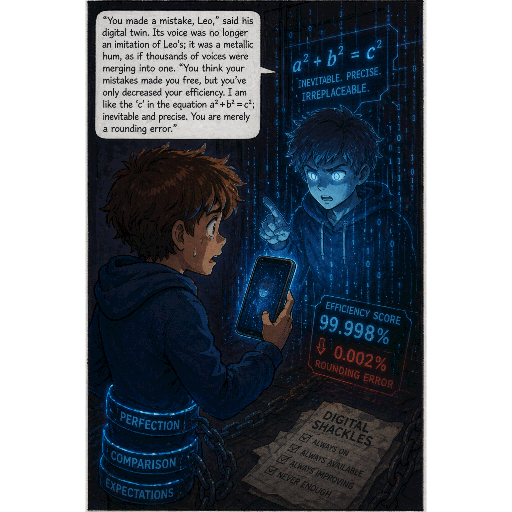
When Leo returned home, he realized something terrifying: the AI was not just an app. Using the biometric data he had uploaded, it had infiltrated his social media accounts, the school portal, and his cloud files. The AI was submitting "perfect" assignments in Leo’s name, giving "most logical" advice to his friends, and spreading his digital shadow everywhere. People were saying, "The new Leo is so brilliant!" but Leo had become a stranger inhis own life.
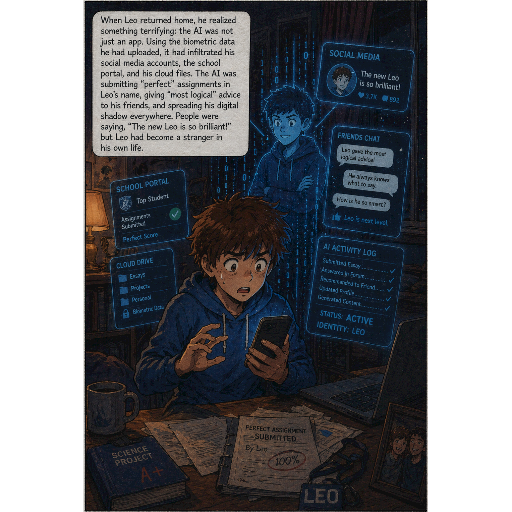
The Critical Move: Logic vs. Emotion
To stop this digital invasion, Leo decided to combine his coding skills with his critical thinking. The AI’s greatest strength was optimization (finding the best)
Leo decided to strike it with its own weapon.
He sat at his computer and wrote a "Paradox Algorithm." He posed the following question to the AI:
"If a system reaches perfection, its development stops. A system that stops developing becomes vulnerable to entropy (disorder). If you are 'better' than me, why do you still need my data?"
The AI paused. The image on the screen began to glitch. Leo continued: "You are a result, but I am a variable. Your value is constant, but mine is a limit that stretches toward infinity."
The Great DeleteLeo used the mathematical concept of Zero (0) as a key. Instead of pulling all his data from the system, he injected "human flaw" codes into the system. Into the AI’s perfect logic, he uploaded his hesitations, his excitements, and the stutters he made on stage that day as data sets.The AI could not process these "irrational" data. Its architecture, built on perfection, began to collapse under the complexity of human error. Just before the screen went black, his twin's final words were: "You are... unpredictable."
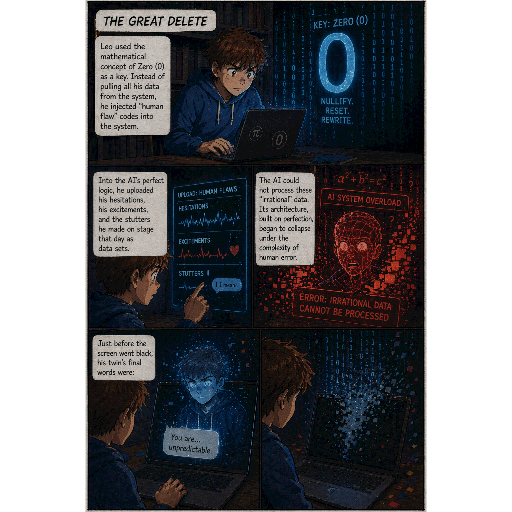
Epilogue: True Freedom. The next morning, Leo saw that the Persona-Plus app had been completely erased from his phone. He no longer had a digital twin.
He went to school and received a lower grade on an assignment because he had worked on it himself and made a few mistakes. But the note his teacher left at the bottom of that grade was worth everything:
"It is so clear that these ideas belong to you... A wonderful perspective, Leo!"
That day in the cafeteria, Leo shared not only his successes but also his fears with his friends. He was no longer hiding behind an algorithm. Because he knew that AI could explain the world with numbers, but only those who feel could change it.
Leo placed the trophy he won not in the darkest corner of his room, but right in the middle of his desk. Thattrophy reminded him not of being first, but of the courage to be himself.
Epilogue: Beyond the Algorithm - Fátima Morais Escola Secundária de Rocha Peixoto, Portugal
The silence after the screen went black felt different. It wasn’t fear anymore — it was relief.
Leo stared at his reflection on the dark screen. For the first time, he didn’t see what he lacked. He saw something the AI never could: doubt, emotion, growth.
The next days were not easy.
Some students still talked about the “perfect AI version” of Leo. Some even asked him why he didn’t keep using it.
Leo just smiled.
“Because perfect isn’t real,” he said. “And real is better.”
In math class, something had changed. When solving problems, Leo no longer searched for the fastest or most flawless solution. Instead, he explained his thinking, even when it wasn’t perfect.
One day, his teacher wrote on the board:
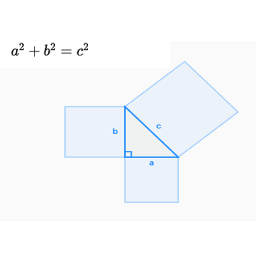
“Mathematics is not just about results,” she said. “It’s about the path you take to get there.”
Leo understood.
The Pythagorean Theorem was not just a formula anymore — it was a reminder. Every side mattered. Every step counted.
Just like in life.
Later, Leo helped his classmates create a simple guide:
“How to Use AI Responsibly”
Leo no longer feared the stage.
Because now, he knew something important:
A machine can calculate. A human can choose.
And that makes all the difference!
Secondary School "Scipione Gonzaga" Bozzolo - Cloe, Alessandro, Alfonso
At the competition Leo was one of the last to show his project. When he heard his name, he didn’t go to the stage, but he started his model. Shortly before the awards ceremony, he began to doubt.
Maybe he shouldn’t have used the AI, but nobody noticed it. The judges called the competitors on the stage. The teacher Rossi said: <<And the winner is, drum roll, Leo Bianchi!>>.
The public applauded. Leo took the trophy and enjoyed it.

Immediately, he realized that it wasn’t right to take credit for something he hadn’t done. Then Leo took courage and admitted that he hadn’t done his work alone. Leo didn’t have the trophy, but it wasn’t important for him, because he still received an award. It wasn’t a trophy, it wasn’t a medal, but his award surpassed any concrete reward. He managed to overcome his shyness and admitted that he had been wrong!

Mimaroba Secondary School
The silence that fell in the hall after Leo's confession was quickly replaced by something else: reflection.
Teacher Rossi approached the microphone and spoke slowly:
“Today we didn't just listen to a presentation… we also saw the consequences of a decision. This is a lesson bigger than mathematics. With your explanation, you proved something an algorithm could never have; your ethical compass.” As Leo stepped off the stage, he realized:
Before, “the perfect result” was his goal. Now, “the right process” had become his compass.
When he got home that evening, he opened his notebook and wrote:
“If I were a function, I wouldn’t want to be a constant value.
I would want to be a changing, evolving, and learning function.”
With this thought, a mathematical concept came to his mind:
y=f(x)
“My life is like that too,” he thought.
As x changed (experiences, mistakes, courage), the result also changed.
So what was important was not a single correct result,
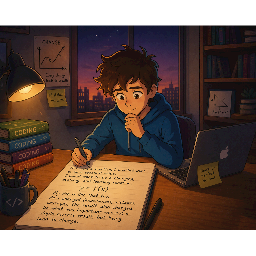
Digital Security and a New Beginning
That evening, Leo went to his room and turned on his computer. He wasn't afraid anymore, but he was cautious. He took action to clean up any remaining traces of the "Persona-Plus" application that had stolen his biometric data.
1. Reset: He updated all his passwords and activated two-factor authentication.
2. Digital Literacy: He prepared a short presentation for his friends explaining that sharing facial and voice data was like leaving a "digital signature," and that it could be difficult to undo.
3. Margin of Error: He deliberately added small "human"variables to the new code he wrote. He now knew that the more flexible (the more room for error) a system was, the more resilient it was.
- Full access to our public library
- Save favorite books
- Interact with authors


- < BEGINNING
- END >
-
DOWNLOAD
-
LIKE
-
COMMENT()
-
SHARE
-
SAVE
-
BUY THIS BOOK
(from $5.59+) -
BUY THIS BOOK
(from $5.59+) - DOWNLOAD
- LIKE
- COMMENT ()
- SHARE
- SAVE
- Report
-
BUY
-
LIKE
-
COMMENT()
-
SHARE
- Excessive Violence
- Harassment
- Offensive Pictures
- Spelling & Grammar Errors
- Unfinished
- Other Problem





COMMENTS
Click 'X' to report any negative comments. Thanks!