

Alex loved looking at the stars, but one evening, a question popped into his mind.
"Stella," Alex asked his glowing star friend, "why do scientists keep talking about carbon emissions and climate change.
Stella twinkled brightly. "Great question, Alex! Every time we burn fossil fuels, such as coal, oil, and natural gas, we release carbon dioxide into the atmosphere. These fuels power cars, factories, and many power plants."
"But isn't carbon dioxide natural?" Alex asked.
"It certainly is!" Stella replied. "Plants need carbon for photosynthesis, and the natural greenhouse effect helps keep Earth warm enough for life. However, when humans activities release excess carbon, more heat gets trapped in the atmosphere. This contributes to global warming and climate change.
Alex looked worried. "So how can we get the energy we need without adding so much carbon?"
"That's exactly what scientists are trying to solve," Stella said. "We can use renewable energy sources like sunlight and wind, and scientists are also researching nuclear energy. To understand why nuclear energy is so powerful, we need to look up at the stars!"
Alex grinned. "Then lets explore the universe!"
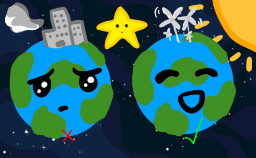

Reducing carbon emissions can help protect Earth and it's future
As Alex and Stella traveled through space, they spotted a giant cloud of gas of dust "What is that?" Alex asked.
"That is a nebula!" Stella explained "Stars begin forming when gravity pulls gas and dust together. As the material gets squeezed, its temperature and pressure rise. Eventually, the center becomes hot enough for nuclear fusion to begin." "Fusion?" Is that what makes Stars shine?" Alex asked.
"Exactly! During fusion, small atomic nuclei combine to form larger nuclei releasing energy. In our sun hydrogen nuclei combine through a series of reactions to form helium. The released energy eventually reaches space as light and other electromagnetic radiation." A;ex watched a nearby star glow. "Does every star live forever?"
"No star lives forever," Stella answered. "A star spends much of its life in a stable stage, balancing the inward pull of gravity with the outward pressure created by its hot interior"
Stella continued,"When a sun-like star runs low on hydrogen fuel in its core, it expands into a red giant. eventually it releases its outer layers, leaving behind a hot core called a white dwarf. "What about really massive Stars?" Alex wondered
"They can become red super-giants and eventually explode as supernovae. Depending on the star's remaining core, the result may be a neutron star or a black hole."
Alex starred in amazement. "So even when a star dies, it can help create something new!"
"Absolutely," Stella replied. "A star's life and death help shape the universe around us."
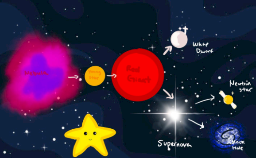
Stars change their lives eventually becoming different kinds of stellar remains
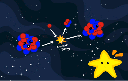
As they passed a colorful nebula, Stella handed Alex a tiny model of an atom. "Everything around you is made of atoms," she explained. "An atom has a nucleus containing protons and usually neutrons, surrounded by electrons." Alex examined the model." How do we know which element an atom belongs to?" "The number of protons determines the element," Stella answered "Hydrogen has one proton, carbon has six, and oxygen has eight. Change the number of protons and you have a different element!" "What if two atoms are the same element but have different numbers of neutrons?"
"They are called isotopes," Stella said. For example, carbon-12 has six protons and six neutrons. Both are carbon because they each have six protons."
Alex noticed some nuclei in the model were marked as unstable. "Why are some atoms unstable?"
"A nucleus can be unstable when its combination of protons and neutrons does not have a stable balance. Some unstable nuclei release particles or energy to move toward a more stable state. This process is called radioactive decay."
Stella showed him threw examples. "Alpha decay releases an alpha particle, beta-minus decay changes the neutron into a proton while releasing an electron, and gamma decay releases high-energy electromagnetic radiation from the nucleus." "Does that mean radioactive atoms disappear?" Alex asked "Not exactly. Radioactive decay changes the nucleus. Depending on the type of decay, the atom may become a different element or a different nuclear state. Some radioactive isotopes are useful in medicine, research, and dating ancient materials." Alex nodded. "So the tiny nucleus can tell us a lot about the world!"
Radioactive decay occurs when an unstable atomic nucleus releases particles or radiation
"Stella," Alex asked, f everything is made of elements, where did all the elements come from?" Stella smiled. "That question takes us all the way back to the beginning of the universe!" She pointed toward a bright image of the early universe. "After the Big Bang, the universe formed mostly with hydrogen and helium, along with small amounts of lithium. Later gravity gathered gas into stars." "And then the stars made more elements?" Alex asked. "Yes! Through nuclear fusion, stars build heavier elements from lighter ones. Many stars produce carbon and oxygen. Massive stars can create heavier elements in their interiors, up to iron through the stages of fusion." Alex looked surprised. Can stars make every element by fusion?" "Not easily," Stella replied. "Fusing nuclei heavier than iron generally does not release energy in the same way that fusion of ,lighter nuclei does. Many elements heavier then iron form through other nuclear processes, including neutron capture. Some of these processes occur in supernovae and collisions between neutron stars." "Then what happens when a star explodes?" "A supernova can scatter elements into space," Stella explained. "That material can become part of a new stars, planets, and eventually living things." Alex looked down at his hands. "So some of the atoms in my body were made in stars?" "Many of them!" Stella said "The carbon in your body, the oxygen you breathe, and the calcium in your bones have cosmic histories. The elements in our world are connected to generations of stars." Alex gazed at the universe with new appreciation. "We really are connected to the stars!"
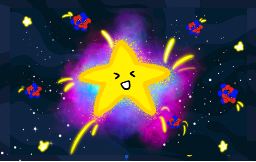
Stars create many elements that eventually become part of planets and living things
Alex and Stella arrived at a futuristic energy laboratory. "Today we're going to compare two nuclear processes," Stella announced. "They are called fusion and fission." She showed Alex a diagram of two small nuclei joining together. "Fusion combines light atomic nuclei to form a heavier nucleus. It powers the Sun and other stars. For certain reactions, the products have slightly less ,mass than the original particles. That difference in mass is releases as energy, according to Einstein's famous equation. E=MC^2." "Does fission work the opposite way?" Alex asked. "Exactly! Nuclear fission splits a heavy nucleus into smaller nuclei. It can release energy and additional neutrons. Nuclear power plants use controlled fission reactions to produce heat, which is used to generate electricity. " Alex compared the two diagrams. "So fusion joins, and fission splits!" "You got it," Stella said "Both can release enormous amounts of energy because small changes in mass correspond to large amounts of energy." "Then why don't we use fusion for all our electricity already?" Alex wondered. "Fusion is extremely difficult to control on Earth," Stella explained. "Scientists must create the right conditions for nuclei to fuse and develop systems that produce reliable, practical electricity. Fission already provides electricity today, while commercial fusion electricity remains a future goal." Alex grinned. "Two different processes, both important to understanding nuclear energy!"
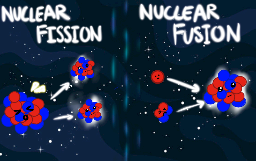
Fission splits a heavy nucleus, while fusion joins lighter nuclei
- Full access to our public library
- Save favorite books
- Interact with authors
Join Alex and Stella on an amazing journey through space to discover the secrets of stars, the elements, and the power of nuclear energy!
Explore how stars create elements, uncover the difference between fusion and fission, and discover how scientists are working toward cleaner energy for our planet.
Recommended for curious readers in 8th grade.
- < BEGINNING
- END >
-
DOWNLOAD
-
LIKE
-
COMMENT()
-
SHARE
-
SAVE
-
BUY THIS BOOK
(from $2.99+) -
BUY THIS BOOK
(from $2.99+) - DOWNLOAD
- LIKE
- COMMENT ()
- SHARE
- SAVE
- Report
-
BUY
-
LIKE
-
COMMENT()
-
SHARE
- Excessive Violence
- Harassment
- Offensive Pictures
- Spelling & Grammar Errors
- Unfinished
- Other Problem





COMMENTS
Click 'X' to report any negative comments. Thanks!