- To my brain, for coming up with six completely different stories instead of letting me relax.

Table Of Contents
Learning the rhythm . . . . . . . . . . . . . . pages 4 - 15
The star in the ruins . . . . . . . . . . . . . . . pages 16 - 23
the weight of time . . . . . . . . . . . . . . . . . pages 24 - 32
how to make mango sticky rice . . pages 34 - 44
the quiet heart of vietnam . . . . . . . pages 46 - 55
Candle lights and communion . . . pages 56 - 66

After Michael’s plane finally lands on the runway and comes to a complete stop, he stands, picks up his bags, and goes out into the world to finally explore this new experience. Making his way through the crowds of people and going out into the public to explore, he looks around and notices the roaring sounds of the public Japanese civilians.
He feels his heart drop, looking around, seeing what seems like thousands of people all around him.
“Oh my goodness…” He says to himself softly.
He takes a deep breath and starts making his way toward the crowd, carrying his backpack behind him, slightly weighing him down.
At first, everything felt under control. He followed the crowd, blending in and observing as many passers accidentally bump and crash into each other, others struggling to find exits, bathrooms, their next flight, and some of their lost family members in the deafening crowd.
He pulls his phone out of his pocket using a guide or GPS to make his way toward the exit, but suddenly his phone flickers a bit before going black…
“No...no, no,” he muttered, pressing the screen multiple times and trying to turn it on, but it gave no response. “You’ve got to be kidding me.”
The crowd didn’t stop. People rushed past him as if nothing had changed.
Michael stood still. For the first time, he felt lost.
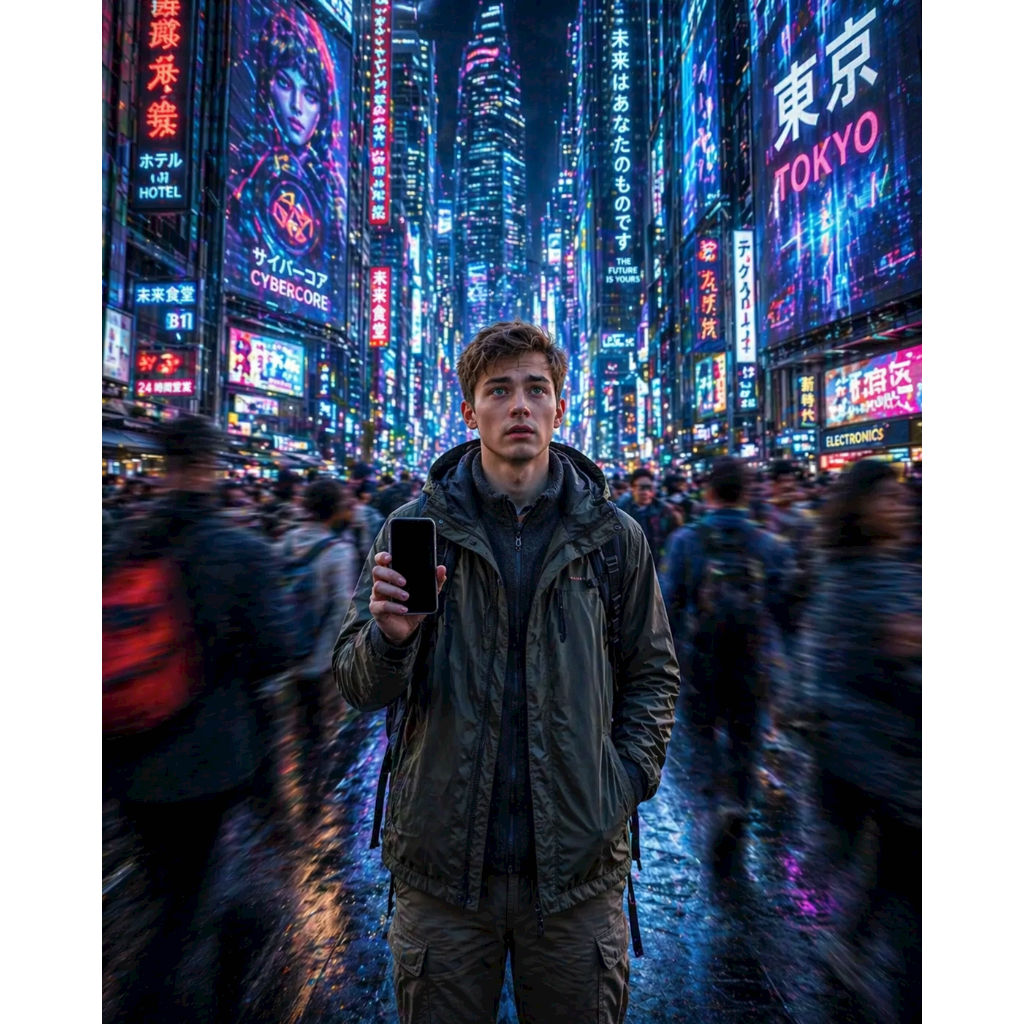
As Michael tries to keep up with the flow of the crowd with their smooth, impeccable movement, somehow everything he did to keep up with them just wasn’t enough mumbling to himself, “How are they so in sync?” while he shakes his head, trying to make sense of it.
He was gazing and admiring the bright signs above his head, flickering letters and texts he had never seen before. He tries to understand their meaning, but he only ends up getting lost even more. The Japanese language is frankly too complicated for him to understand, but he just keeps walking through the crowd.
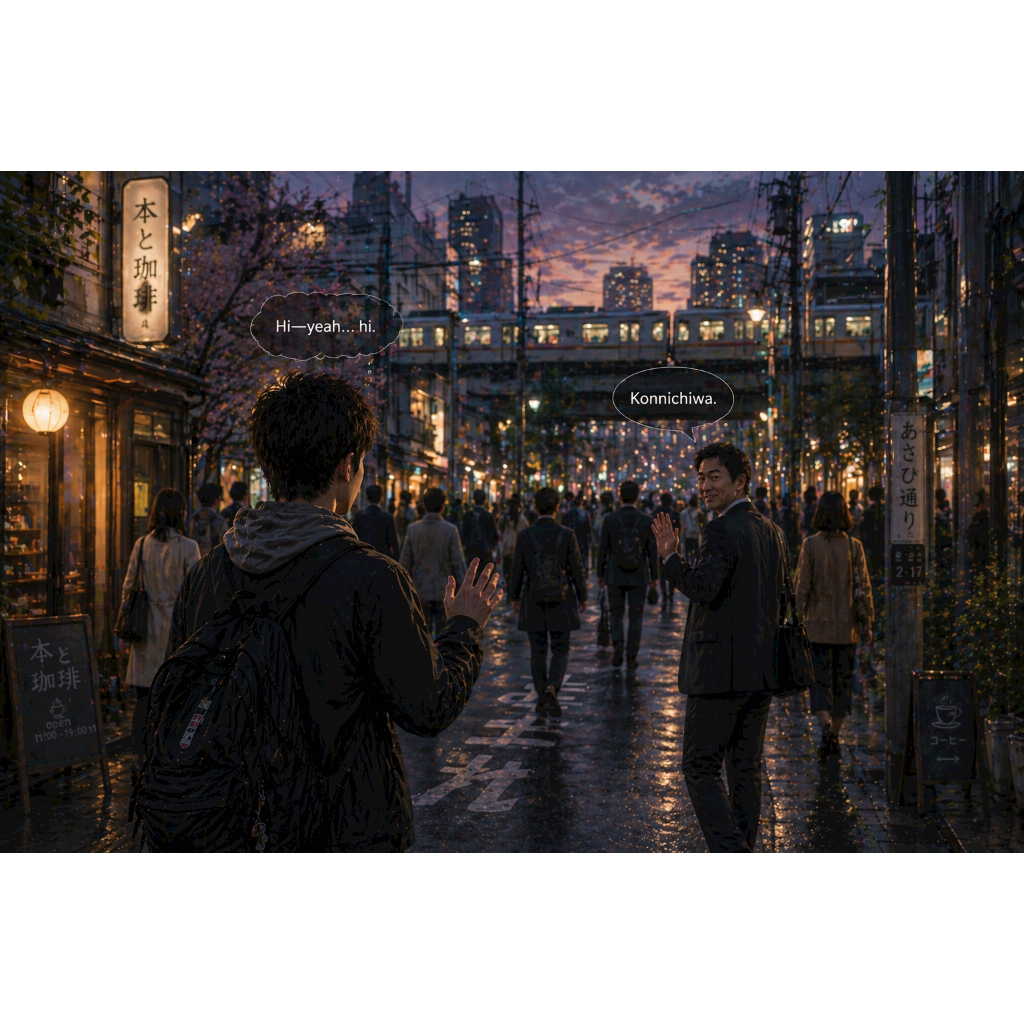
At one crosswalk, Michael stopped awkwardly and did not know when it was the right time to cross. He looked at the people next to him, observing them, who just seemed to be in harmony, while he looked like a buffoon, a doofus in the middle of a crowd of geniuses.
As a local passes by him without noticing the confusion on his face, they give Michael a friendly nod and say “Konnichiwa (Hello/Good afternoon),” With so much going on, Michael fails to hear him and can only reply with an uncomfortable and awkward smile and small wave. As the crowd starts to move, he decides instead of moving fast, he will move more slowly and observe the crowd, how they were lining up, and their behavior, and wonder how everything moved smoothly.
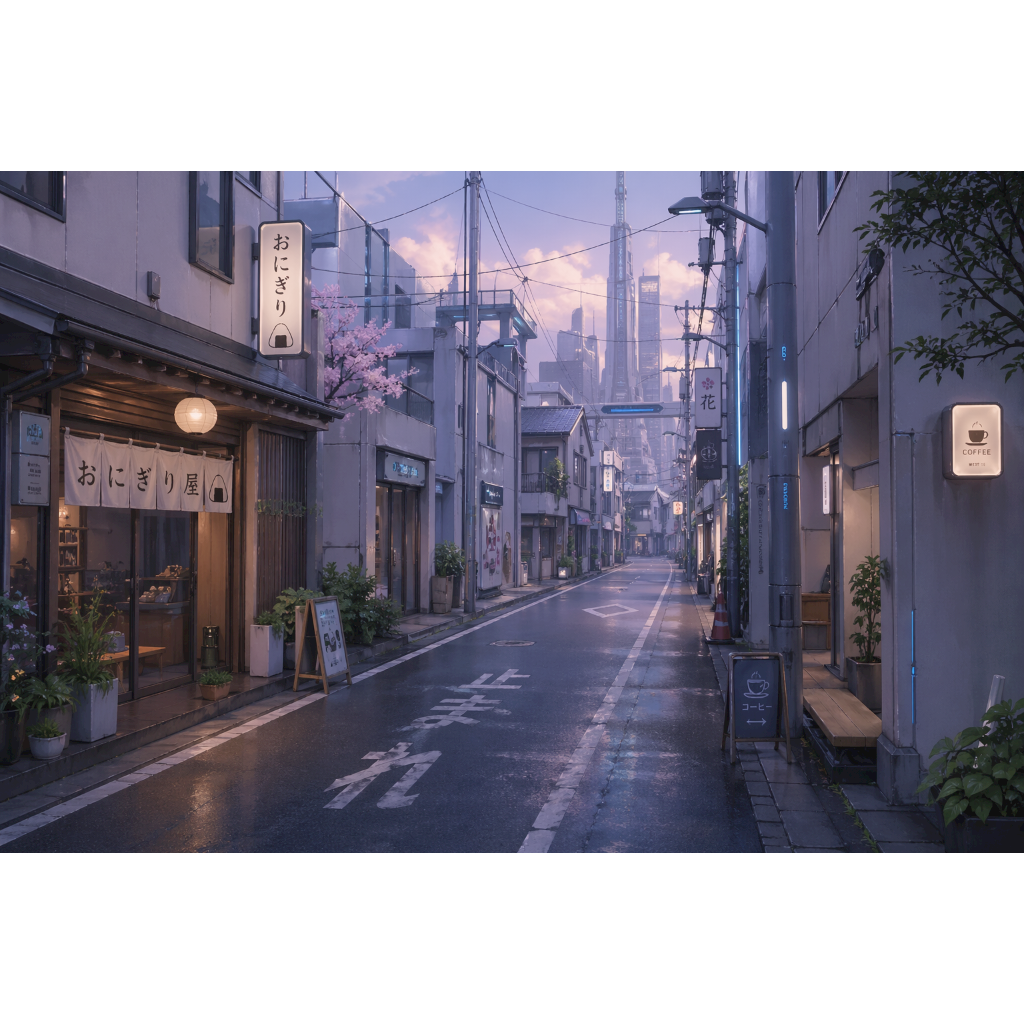
Michael, being unsure what to do next, decides to continue walking. He finds himself on a side road, expecting to see another crazy scene, but instead it's a calming place.
After relaxing, Michael whispers to himself, “I can do this now. Just have to slow my pace, and I'll be fine.” “No more guessing, but rather I’ll watch them move.”
As he entered back on the main sidewalk, he slowed at first; it was the same as before, when he would bump or end up getting pushed, but over time, he got into the rhythm, and he felt that he was starting to adapt to the new life.
The crowd seemed to swallow him whole, voices crashing over each other in a language he barely understood. The smell of street food, perfumes, colones, everything mixing into this overwhelming blur of smell and sounds. Every direction turned into the wrong one. Michael's chest tightened, panic rising like a wave he couldn't outrun.
“Left? No. Right? No, none of this feels right.”
Michael's thoughts spiraled, his logic slipping, and for a second, it felt like he couldn't breathe. Then he froze again, not to try to escape but to breathe. He took a deep breath, and the cool breeze of the wind and the warm feeling of spring rested on his shoulders. Then, suddenly, as if it wasn't himself doing anything, he started to walk again with the crowd, making his way through people like he was part of them, even if they gave him glances of confusion and concern, he just kept walking like nothing ever happened, then suddenly the crowd broke. Michael practically ran closer to the open space, letting out a long breath like he had survived something dangerous.
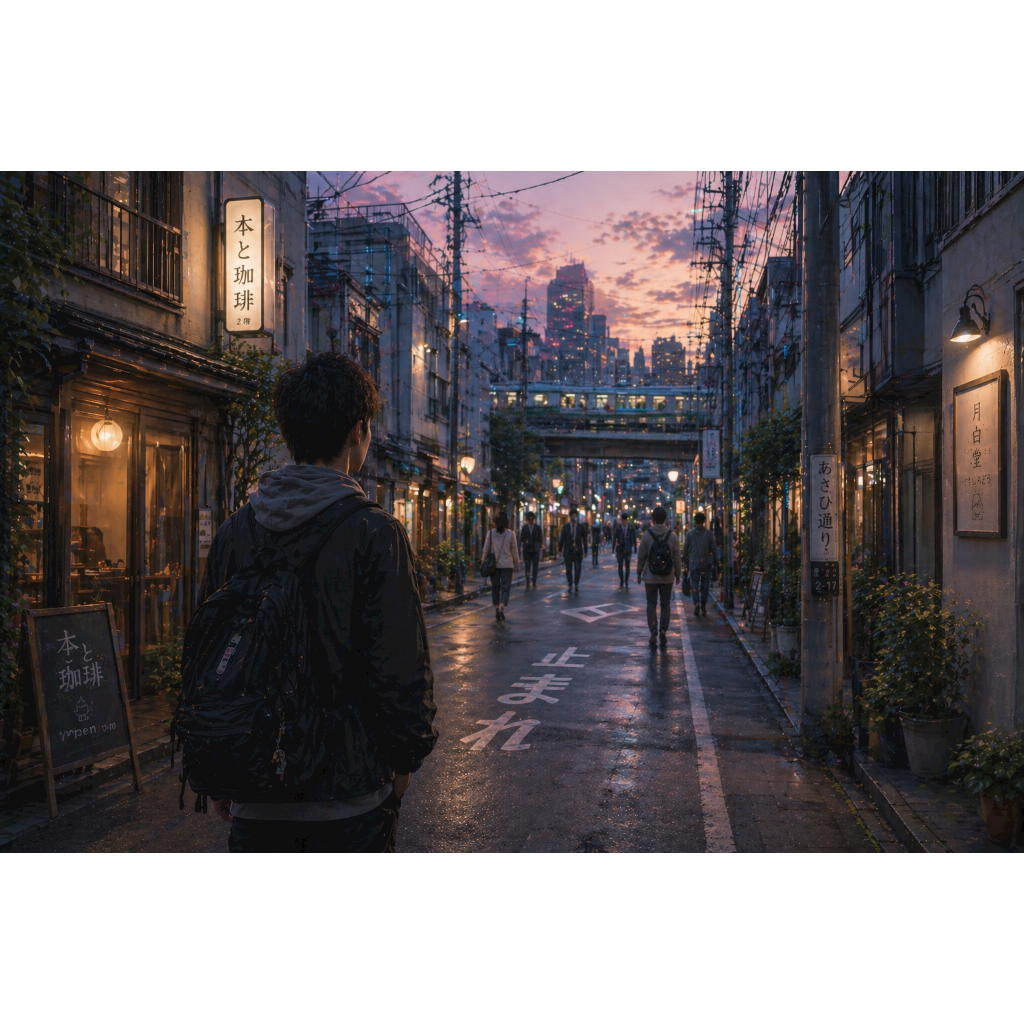
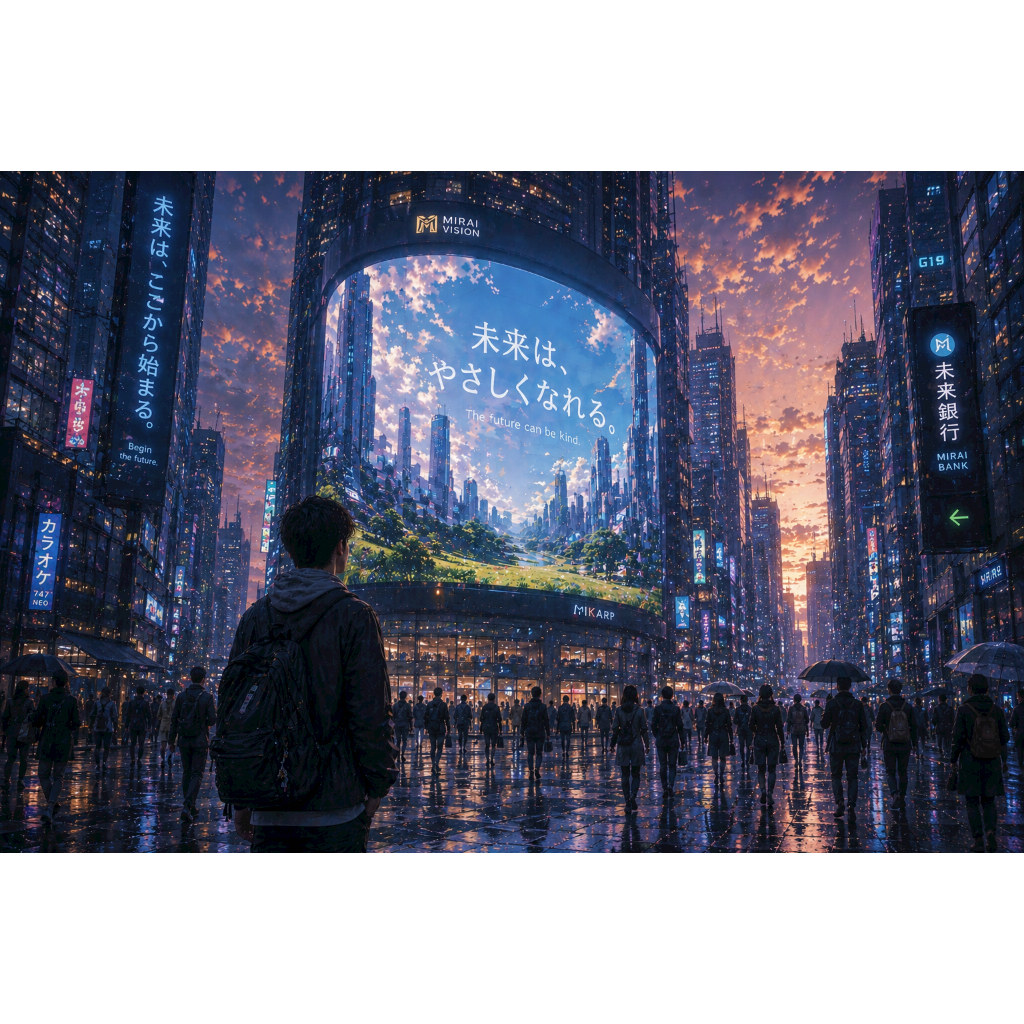
Moments later, he spotted a familiar digital billboard glowing above the skyline.
Relief washed over him as he recognized the text and familiarity.
“I made it,” he said quietly, rubbing the worry off his forehead.
As he arrives at the building, he turns around and continues to walk down the sidewalk. He realizes that fighting its rhythm only left him more lost. By moving along with the city, he finds comfort and begins to find his direction. As he kept walking, he really began to deeply notice that beneath the speed of the city, there was balance. The small ramen shops tucked between busy streets and the soft glow of lanterns in narrow alleyways reminded him that even in chaos, there was peace. Rather than resisting, he began to let himself move with the flow rather than fighting it, and for the first time since arriving, he no longer felt lost. His heart filled with a sensation of belonging and peace, starting to enjoy himself in the midst of the chaos.

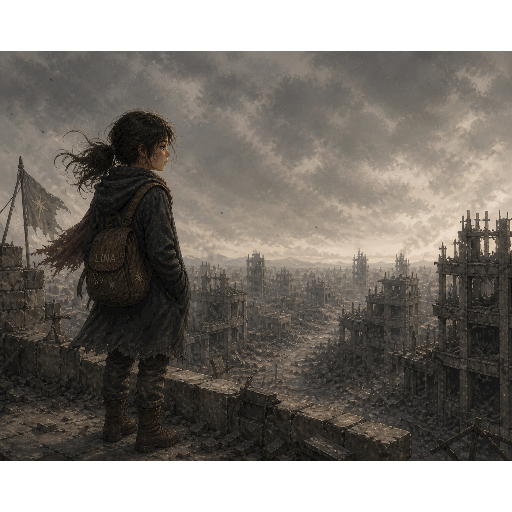
The city was once full of life, but now it was covered in ash and silence. Broken buildings stood on both sides of the street, and old signs swayed in the wind. Dust floated through the air like gray snow. Everything felt cold, empty, and forgotten. Still, Lina kept walking through it every day. She checked the same broken streets, the same abandoned corners, and the same ruined train station, because she believed there was still something left to find.
Lina was sixteen and adopted. Her mother had disappeared years ago, and most people thought she was gone forever. Most people had stopped hoping she would come back, but Lina did not. Even when the search felt useless, she kept going back out into the ruins. Her older brother Thomas was the complete opposite. He was tired of waiting and tired of getting his hopes up.
One morning, Lina was getting ready to leave when Thomas stopped her.
“You’re going out again?” he asked.
“Yes,” Lina said.
“For what?”
“To find Mom.”
Thomas shook his head. “Mom has been missing for years. You need to stop chasing something that isn’t there.”
Lina looked at him with frustration. “She left for a reason. I know it.”
“That’s hope talking,” he said. “Not reality.”
Lina did not answer right away. She knew Thomas was only trying to protect her, but his doubt made her feel even more determined. She remembered what her mother used to say before she disappeared: Hope is what keeps you moving when everything else tells you to stop.
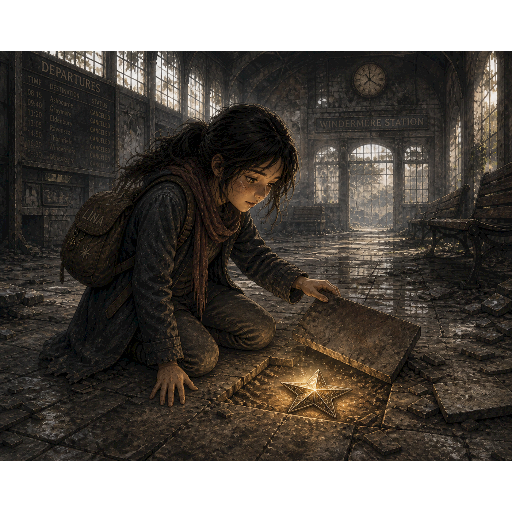
That afternoon, Lina searched an old train station on the edge of the city. The windows were broken, and the floor was covered in dust, but something caught her eye under a loose tile. She bent down and pulled out a small metal star. Her heart started beating faster when she saw the same symbol her mother used to draw on maps.
On the back of the star were three words: Follow the light.
Lina stared at the message in disbelief. Her fingers tightened around the metal until it felt warm in her hand. For the first time in a long time, the search did not feel pointless. It felt possible. Maybe her mother was still alive. Maybe she had been leaving clues all along.
When Lina showed Thomas the star, he looked unsure. “Are you sure it means something?” he asked.
“I’m sure enough to keep going,” Lina said.
Thomas was quiet for a moment. Then he sighed and said, “Then I’m coming with you.” Lina was surprised. “You believe me now?”
“I don’t know if I believe everything,” he admitted, “but I believe in you.”
The next morning, they left the city together and followed the old road beyond the barricades. The journey was hard. The wind was strong, and the ash made it difficult to see. Lina started to doubt herself for a moment, but she kept moving. Then she noticed a soft glow ahead.
“Thomas,” she whispered.
They climbed a small hill and stopped.
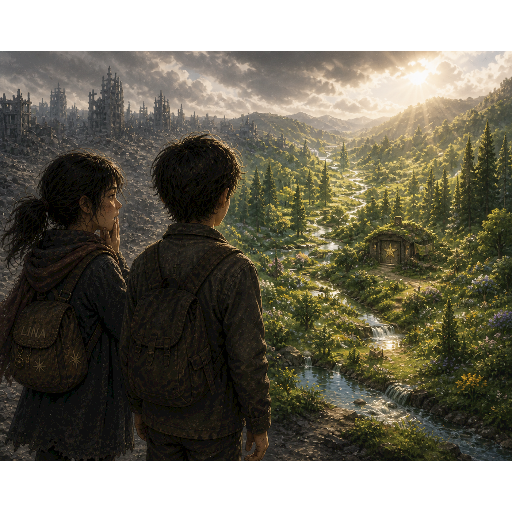
Below them was a hidden valley full of green grass, tall trees, and a clear stream. After all the gray and ruin, it looked almost unreal. In the middle of the valley stood a small shelter with the same star symbol painted on the door.
Lina’s eyes filled with tears. “It’s real,” she said.
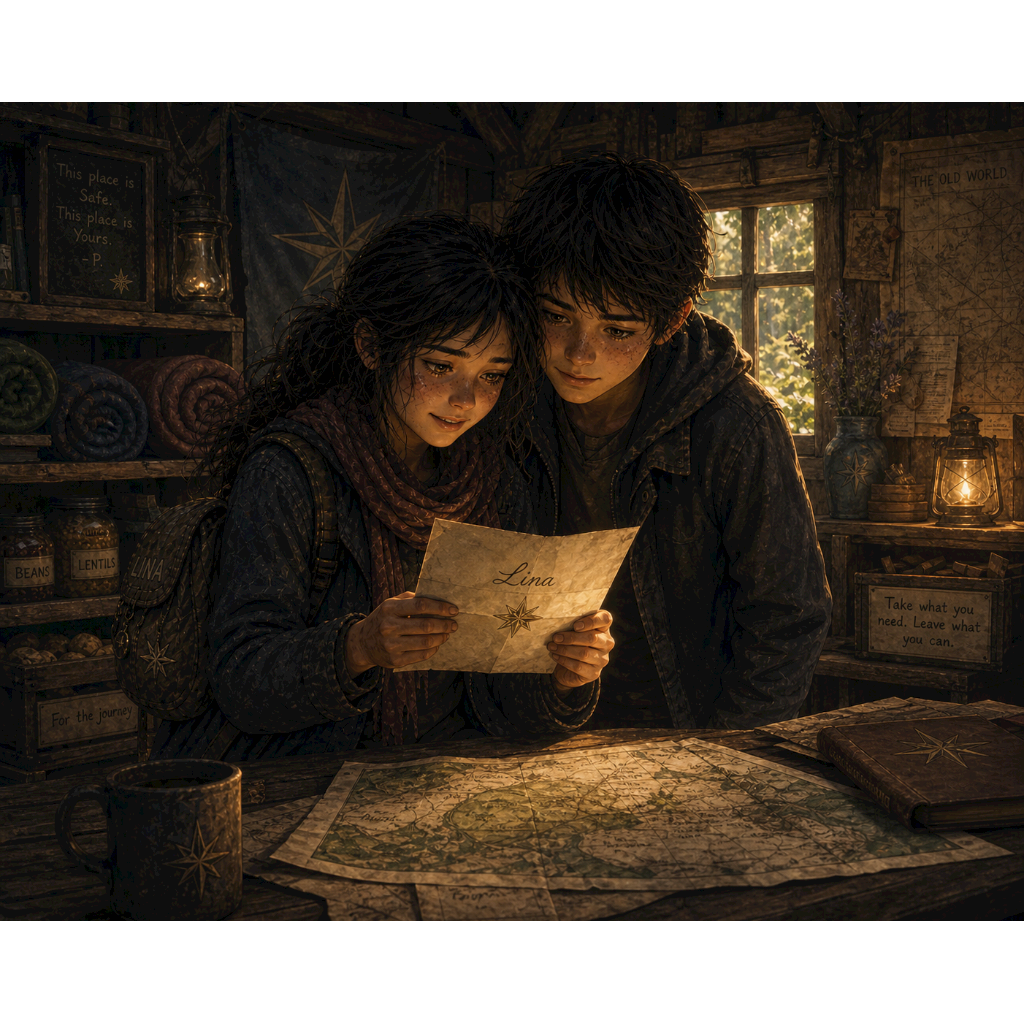
Inside the shelter, they found blankets folded neatly in the corner, shelves of food, maps pinned to the wall, and a letter with Lina’s name written on it. Lina opened it carefully, her hands shaking. As she read, her breath caught in her throat. Her mother had survived and built this safe place for people who needed it. She had left clues because she wanted Lina to find her one day. Every object in the shelter felt like proof that her mother had never stopped loving her, never stopped planning, and never stopped hoping either.
Thomas read the letter too, and his face changed. For the first time, he looked hopeful.
Lina smiled through her tears. She had not found an easy ending, but she had found answers. Hope had led her through fear, doubt, and sadness. It had also brought Thomas with her in the end.
Lina learned that hope is not pretending everything is fine. It is choosing to keep going even when life is hard. Sometimes, hope leads to surprising answers.
Sometimes, it helps people find what they thought was lost forever.

Lina Tran had always been uneasy around the old clock sitting on her grandmother’s dresser. It was made of brass, but age had dimmed its shine so much that it looked brown in some places and gold in others. Its glass face held a thin crack near the edge, and the hands moved with a faint, uneven tick that filled the silent room. The clock was heavier than it looked, and when Lina picked it up, a strange chill ran through her fingers. The room smelled of dust and old wood, softened by the fading trace of jasmine that still clung to her grandmother’s clothes.
Her grandmother had passed away only a month earlier, and the house still felt frozen in grief. Lina often stood in the doorway of the bedroom, staring at the dresser as if her grandmother might return at any moment and smile at her from the bed. She missed her stories. She missed her warm tea. She missed the way her grandmother always seemed to understand what she was thinking before she said a word.
One rainy evening, while thunder rolled softly outside, Lina reached for the clock and turned the knob at the back. She did not expect anything to happen.
The ticking stopped.
Then, to her shock, it began ticking in reverse.
The room flickered.
Lina blinked, and the air changed. The bedroom grew brighter, younger, warmer. Laughter drifted in through the window. She turned and saw her grandmother standing by the bed, alive, humming softly as she folded laundry. Lina gasped and stepped back. The clock glowed faintly in her hand.
It had not just stopped time.
It had rewound it.
At first, Lina only used the clock for small things. If she dropped a glass, she could twist the knob and catch it before it broke. If she said something awkward in class, she could try again. If she made a mistake, she could erase it. If something went wrong, she could fix it. These moments felt harmless—almost comforting. Slowly, quietly, she began to rely on it.
She began to believe that if she used it carefully enough, she could fix anything. Maybe even bring back what she had lost.
One night, holding an old photo of her grandmother, Lina whispered, “What if I could go back farther?”
She twisted the knob again, harder this time.
The world snapped.
She stood in a park she barely remembered. Children ran across the grass, sprinklers sprayed into the summer air, and sunlight shimmered across everything. On a nearby bench sat her grandmother, younger and smiling, watching a little girl—Lina—play in the distance.
Tears filled Lina’s eyes.
This was what she wanted.
This was her chance.
She stepped forward.
The sky flickered.
The laughter warped, stretching thin and distant, like a recording losing power. The clock in her hand grew hot—too hot. A low voice whispered, close and cold, “You are not supposed to be here.”
Lina froze.
The world stopped.
The clock’s hands spun too fast to see.
Fear rushed through her, sharp and sudden. She understood then: the clock was not meant to hold her in the past. It was not meant to erase pain. It was not meant to undo loss. Time itself was straining, breaking under the weight of her wishes.
“I just wanted more time,” she said, her voice trembling.
The clock cracked loudly in her hand.
In that moment, Lina made a choice. Not to go back. Not to stay. But to move forward.
She turned the knob as far forward as it would go.
Light burst around her, blinding and absolute.
When she opened her eyes, she was back in her grandmother’s room. The rain had stopped. The clock sat silent in her hands, its glow gone, its face fractured beyond repair.
No magic. No second chances.
Just time, moving as it should.
Lina placed the clock gently back on the dresser.
She stood there for a long moment, listening to the quiet. Then she looked around the room and felt the truth settle in—not harsh, but steady. She could not bring her grandmother back. She could not change the past. But she could carry the love her grandmother gave her into the future.
For the first time since the funeral, Lina felt a small, steady sense of peace. The grief was still there, but it had softened, its edges no longer sharp enough to cut so deeply. She walked to the window and watched the clouds drift apart, letting pale sunlight fill the room.
“I’ll be okay,” she whispered.
And for the first time, she believed it.

Mango sticky rice is a sweet and creamy dessert that is popular in many Asian countries, especially Thailand. The dessert combines soft sticky rice, rich coconut sauce, and fresh ripe mangoes to create a flavorful treat. Although mango sticky rice may seem difficult to prepare, it can actually be made at home by carefully following each step. The most important parts of the recipe are properly soaking the rice, making the coconut sauce correctly, and choosing ripe mangoes. If each step is completed carefully, the final dessert will be soft, sweet, and delicious.
First, rinse the glutinous rice carefully. Place the rice into a bowl and cover it with cool water. Use your hands to gently swirl the rice around in the water. The water will become cloudy because of the extra starch. Pour the water out carefully without losing any rice. Repeat this process three or four times until the water looks much clearer. Washing the rice is important because it prevents it from becoming too sticky or gummy after cooking.
Next, soak the rice in clean water for at least four hours, although soaking it overnight works best. Make sure all the rice is fully covered with water while soaking. This step softens the grains and helps the rice cook evenly. If the rice is not soaked long enough, the center of the grains may stay hard after steaming. After the soaking time is complete, pour the rice into a strainer and allow all the water to drain completely.
Then, prepare the steamer. Fill the bottom of the steamer or pot with water, but make sure the water does not touch the rice while steaming. Line the steamer basket with a thin cloth or parchment paper so the rice will not fall through the holes. Spread the soaked rice evenly across the basket. Turn the stove to medium heat and cover the steamer with a lid. Steam the rice for about twenty-five to thirty minutes. Halfway through cooking, carefully flip or stir the rice so it cooks evenly. The rice should become soft, shiny, and chewy when finished. Use caution when removing the lid, because the hot steam can burn your hands or face.
Meanwhile, make the coconut sauce. Pour one cup of coconut milk into a small saucepan and place it on the stove over low to medium heat. Slowly add one-third cup of sugar and one-half teaspoon of salt. Stir constantly so the sugar dissolves evenly into the coconut milk. Keep the heat low because coconut milk can separate or burn if it boils. The mixture should stay smooth, warm, and slightly thickened, not bubbling. Once everything is fully dissolved and blended, remove the saucepan from the heat and set the sauce aside. If the sauce starts to boil or separate, lower the heat right away and stir gently to bring it back together.
After the sticky rice has finished steaming, transfer it into a large mixing bowl while it is still hot. Immediately pour most of the warm coconut sauce over the rice, saving a small amount for serving. Use a spoon or spatula to gently fold the sauce into the rice, making sure all the grains are evenly coated. Be careful not to mash the rice while mixing. Once combined, cover the bowl and let it sit for about fifteen to twenty minutes so it can absorb the coconut flavor fully and become soft and creamy.
While the rice is resting, prepare the mangoes. Place a mango on a cutting board and use a knife to carefully peel the skin. Slice the fruit away from the pit, then cut the mango into neat slices or small cubes. Repeat with the second mango. Always cut on the board, not in your hand, to stay safe while using the knife.
Finally, once the sticky rice has absorbed the coconut sauce, it is ready to serve. Place a scoop of the sticky rice onto a plate or into a bowl. Arrange several slices of ripe mango next to the rice. Then, drizzle the remaining coconut sauce over the top for extra sweetness and flavor. If desired, sprinkle sesame seeds or crispy mung beans on top to add texture and decoration. Mango sticky rice is best served fresh, while the rice is still warm and soft and the mango is cool and juicy.
- Full access to our public library
- Save favorite books
- Interact with authors
- < BEGINNING
- END >
-
DOWNLOAD
-
LIKE
-
COMMENT()
-
SHARE
-
SAVE
-
BUY THIS BOOK
(from $12.99+) -
BUY THIS BOOK
(from $12.99+) - DOWNLOAD
- LIKE
- COMMENT ()
- SHARE
- SAVE
- Report
-
BUY
-
LIKE
-
COMMENT()
-
SHARE
- Excessive Violence
- Harassment
- Offensive Pictures
- Spelling & Grammar Errors
- Unfinished
- Other Problem
"Stitched Together six stories. one collection."






COMMENTS